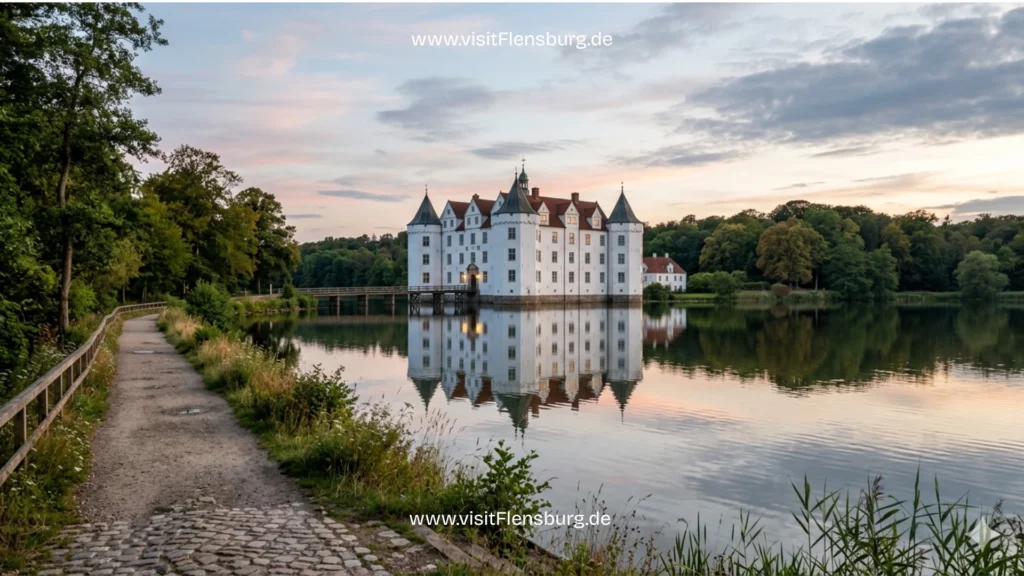
The castle sits in a lake. That is the first thing you notice — not the white-plastered walls or the three gabled rooflines, but the fact that it floats. Schloss Glücksburg is a Wasserschloss, a water castle, and when you come through the tree-lined approach road and see it for the first time across the surface of the castle pond, the reflection is almost as sharp as the building itself.
It is 15 kilometres east of Flensburg along the Flensburg Firth. The drive takes 15 minutes. And yet a significant number of visitors to Flensburg never make it here — which is, frankly, a waste. Glücksburg Castle is one of the most historically significant Renaissance castles in Northern Europe, the ancestral seat of a family whose descendants still sit on the thrones of Denmark and Norway, and a building that has survived 440 years largely intact. It deserves more than a footnote in your Flensburg itinerary.
This guide covers everything you need before you go: the history, what to see inside, the practical details, and how to make a half-day of it.
What Is Glücksburg Castle?
Glücksburg Castle was built between 1582 and 1587 by Duke John the Younger of Schleswig-Holstein-Sonderburg, on the site of the former Ryd monastery. The monastery’s granite blocks went into the castle’s foundations; its bricks were used in the white-plastered walls that still stand today. The grounds of the monastery were then flooded to create the large pond that almost entirely surrounds the castle, which is why, standing on the approach path, you see water before you see stone.
The castle is one of the most significant Renaissance castles in Northern Europe and was the headquarters of the ducal lines of the House of Glücksburg. The name itself comes from the duke’s personal motto: Gott Gebe Glück mit Frieden — God Grant Fortune with Peace. Above the entrance portal you will find this motto together with the coat of arms and the abbreviation GGGMF.
The building’s footprint is a near-perfect square of three separate houses, each with its own roof, built on a 2.5-metre-high granite foundation that emerges from the water. Octagon-shaped towers of 7-metre diameter flank every corner. The middle section holds the great halls and vestibules; the two side wings contain the residential rooms. It is a compact building by castle standards; you can walk the full exterior in 10 minutes, but what is inside justifies the admission price considerably more than the exterior alone.
The History: How One Small Castle Supplied Thrones to Half of Europe
The castle’s architecture is Renaissance. Its history is something closer to a European royal soap opera that ran for four centuries and produced some of the most consequential dynastic connections the continent has seen.
Duke Johann the Younger built it and died in 1622, having fathered 23 children across two marriages. His descendants divided the castle and estates among them, and the elder line of the Glücksburg family held it through the 17th and 18th centuries, until the line died out in 1779. With the death of the childless Friedrich Heinrich Wilhelm in 1779, the older branch of the family went extinct, and the Glücksburg fief went back to the Danish royal family.
In 1825, the Danish King Frederik VI handed over the castle and title to his brother-in-law, Friedrich Wilhelm from the Holstein-Beck family. Friedrich Wilhelm, raised in Denmark and Prussia, was a direct descendant of the castle’s builder. Together with his wife, Louise Caroline, he founded the younger line of the House of Glücksburg.
Among their ten children was Prince Christian — born at Glücksburg in 1818, destined to become Christian IX of Denmark, and the man who would earn the castle its lasting nickname: the father-in-law of Europe.
His eldest daughter Alexandra married the future Edward VII of England. Daughter Dagmar became the wife of Russian Tsar Alexander III as Maria Fyodorovna. The youngest daughter Thyra married Duke Ernst August of Cumberland, pretender to the throne of Hanover. His son Wilhelm was elected King of Greece as George I in 1863, and his grandson Carl ascended the Norwegian throne as Haakon VII in 1905.
In a single generation, the small castle on the Flensburg Firth connected to the royal houses of Britain, Russia, Greece, Norway, and Hanover. The ducal house of Glücksburg derived its name from the castle and its family members are related to almost all European dynasties. King Frederik X of Denmark, King Harald V of Norway, and King Charles III of the United Kingdom are all members of the House of Glücksburg.
After the death of Friedrich VII at Schloss Glücksburg on 15 November 1863, Christian IX was enthroned. The German-Danish War of 1864 brought the end of the long personal union between the Danish royal house and the Schleswig-Holstein duchies. During the war, Glücksburg Castle served as quarters for Carl of Prussia, then as a field hospital and barracks. When it was over, Prussian King Wilhelm I visited the castle personally to decide its fate. He returned it to the family — a decision that has kept it in family hands to this day.
The castle was transferred to a foundation under the ducal family in 1923 and opened to the public as a museum. Friedrich Ferdinand, Prince of Schleswig-Holstein-Sonderburg-Glücksburg, has chaired the Glücksburg Castle Foundation since 2023. The castle is not a ruin or a theme park. It is a lived-in institution still managed by the family whose name it carries.
What to See Inside the Castle
The interior tour is self-guided using a free audio guide — available in German, Danish, and English — or via the castle’s downloadable app. You can also explore using the new app on your smartphone, which includes child-oriented versions narrated by Drake and Princess Luise Caroline Elisabeth Feodora. Guided tours run on set dates throughout the season (see the practical section below for times and prices).
The rooms you walk through are arranged across three floors, with the grandest spaces on the ground and first floors.
The Knights’ Hall and Banqueting Hall
The central building houses the two largest rooms in the castle, and they set the tone for everything else. The halls and lounges are decorated with portraits of kings, dukes, and other European royal personalities, landscape paintings, exquisite stucco work, elegant porcelain and silverware sets. The arched ceilings and the scale of the spaces give you a sense of how the castle was used — not as a private retreat, but as a functioning ducal court where significant European visitors were received and entertained.
The Calfskin Leather Wall Hangings
This is the interior detail most visitors remember. A particular treasure of the castle is the richly coloured calfskin leather wall-hangings, probably made in a Mechelen workshop around 1680, which can still be seen in the state rooms today. Flemish leather wall coverings of this age and quality are exceptionally rare in Germany. They have survived 340 years in a building that has served as a summer residence, a barracks, and a field hospital — which makes their condition more remarkable.
The Tapestries and Porcelain Collection
Dutch tapestries, Flemish leather wall coverings, stucco ceilings, frescos, 16th-century portraits, mementos of historical significance, and Rococo-era murals are distributed across the residential rooms. The porcelain collection is particularly strong in 18th-century pieces — the kind of objects that moved between European courts as diplomatic gifts and that tell you as much about the political relationships between houses as they do about decorative taste.
The Royal Portrait Gallery
The rooms at Glücksburg are hung with portraits of the family members who lived and visited here across four centuries. Reading the faces alongside the audio guide — which explains who each person was, who they married, and what thrones they ended up on — turns the portrait gallery into something closer to a map of European royal history. The density of connections is genuinely extraordinary for a castle of this size.
The Castle Film
On the ground floor, visitors can watch a 15-minute film covering the castle’s history. Worth watching before you go upstairs — it gives you the chronological framework that makes the individual rooms more legible.
Practical Information for Your Visit
Opening Hours 2026
January 3 to March 31, 2026: Saturday and Sunday, 11am to 4pm. April 1 to April 30, 2026: Saturday and Sunday, 11am to 4pm. May 1 to October 31, 2026: Daily, 11am to 5pm. Last admission is one hour before closing in all periods.
The castle is closed from 22 December to 2 January. For November opening hours, check schloss-gluecksburg.de directly as they are confirmed closer to the season.
Admission Prices
Adults €11 | Children €7 | Family ticket from €15.
Guided tours are priced separately and on top of admission. The standard history tour costs €15.50 per person including admission, on set monthly dates. Group tours in English are available at €69 plus admission per person for groups of fewer than 10, or €7.50 admission plus €59 tour fee for groups of 10 or more. Duration is approximately 90 minutes.
The late-night tour — through the castle by flickering light when all other visitors have gone — runs in July and August. Admission is €22.50 including a glass of sparkling wine. It is bookable through the castle’s online shop.
Regular Guided Tour Schedule
Monthly dates: April — Sundays at 2:30pm. May and June — Saturdays and Sundays at 2pm. July and August — Wednesdays, Saturdays and Sundays at 2pm. September and October — Saturdays and Sundays at 2pm. November — Sundays at 2:30pm. Price: €15.50 including admission. No advance booking required for the public schedule dates.
Parking
The paid parking lot with a view of the castle charges €3.50 for 3 hours, payable via the EasyPark app or by card at the machine. Free parking is available in the surrounding streets, from where the castle is a short walk.
Accessibility
The castle is accessible via a wheelchair-accessible entrance from the courtyard, with a barrier-free toilet on the ground floor. The upper floors are only accessible via spiral staircases and are not barrier-free. The ground floor rooms, the 15-minute film, and the castle exterior are all accessible.
How to Get There from Flensburg
By car: drive east from Flensburg city centre on the B199 (Fördestraße), following signs for Glücksburg. The journey is 15 kilometres and takes approximately 15 minutes in normal traffic. The approach road through the woods is unmarked but the castle signs are clear from the town.
By bus: Bus 21 runs from Flensburg central bus station (ZOB) to Glücksburg. Journey time is around 30 minutes. The castle is a short walk from the Glücksburg town bus stop. Services run regularly throughout the day but check schedules on weekends before relying on a specific time.
By bicycle: The fjord cycling route along the northern shore of the Flensburger Förde is well-marked and genuinely pleasant. The ride from Flensburg takes around 50 minutes at a comfortable pace and follows the water for most of the route.
How Long Does a Visit Take?
Allow 90 minutes for a comfortable self-guided tour of the interior using the audio guide. Add 30 minutes if you want to walk the castle exterior and the grounds around the lake. A guided tour adds another 90 minutes on top of whatever time you spend in the rooms independently.
Most visitors spend between 90 minutes and 2.5 hours at the castle in total. The castle is compact enough that it never feels like a slog — you will not be walking for miles through empty corridors — but the depth of the collection rewards taking it slowly.
If you want to book a guided castle tour or experience before you travel, check available Glücksburg tours on GetYourGuide for options departing from Flensburg.
The Glücksburg Rose Garden
The Glücksburger Rosarium sits in the area of the former castle nursery, a few minutes’ walk from the castle entrance. Created in 1990 and 1991, it grows more than 500 different rose varieties. It is a private garden with its own admission fee, separate from the castle ticket. In June and July, when the roses are at their peak, it is worth the extra stop. Outside those months the garden is pleasant but less remarkable.
Where to Eat Near Glücksburg Castle
The town of Glücksburg is small, but there are a few options within walking distance of the castle.
Marien-Café at Schloss Glücksburg — the castle’s own café, serving coffee, cake, and light lunches. The café supplies the castle’s royal coffee tours, and the cakes are consistently good. Opening hours follow the castle season. This is the easiest option if you want to eat without driving into town.
Restaurants in Glücksburg town — the town centre is a 10-minute walk from the castle and has a small number of restaurants and cafés facing the harbour. The waterfront location makes any of them pleasant in good weather.
For a longer lunch or dinner after visiting the castle, returning to Flensburg gives you the full range of the harbour restaurants along Schiffbrücke. Hansens Brauerei at Schiffbrücke 16 — the former rum house turned brewery pub — is 20 minutes away by car and consistently the best atmospheric option for a post-castle meal.
Combining Glücksburg with a Flensburg Day
Glücksburg Castle works very well as a morning or afternoon add-on to a Flensburg city day. The two fit together naturally in either order:
Morning at the castle, afternoon in Flensburg: Arrive at Glücksburg when it opens at 11am, spend 90 minutes inside, walk the rose garden, then drive back to Flensburg for a late lunch at the harbour. Spend the afternoon at the Flensburg Harbour and the Rum Museum.
Morning in Flensburg, afternoon at the castle: Start with the harbour and old town in the morning, have lunch at Hansens Brauerei, then drive east to the castle for a 2pm guided tour (on days when the schedule aligns). Return to Flensburg for dinner.
If you are travelling without a car, the bus connection works well enough for the castle visit but limits your flexibility for the Flensburg harbour walk — hiring a car makes the combination considerably easier. See the car rental in Flensburg guide for the main options in the city centre.
For accommodation during a trip that includes the castle, hotels in Flensburg are the practical base — the city has a better range of options than Glücksburg town, and the drive is short enough that staying in Flensburg costs you nothing in time. Hotel am Fjord at Schiffbrücke 33 is directly on the waterfront and 15 minutes from the castle by car — a logical combination.
For a full overview of what to see in Flensburg and the surrounding region, the attractions guide covers all six main sites with opening hours and practical details.
How far is Glücksburg Castle from Flensburg?
Glücksburg Castle is 15 kilometres east of Flensburg city centre. By car on the B199 along the Flensburg Firth, the drive takes approximately 15 minutes in normal traffic. Bus 21 from Flensburg’s central bus station (ZOB) takes approximately 30 minutes to cover the route. By bicycle, the fjord cycling route takes roughly 50 minutes.
What are the opening hours for Glücksburg Castle in 2026?
From May 1 to October 31, the castle is open daily from 11 am to 5 pm, with the last admission at 4 pm. In April, it opens daily from 11 am to 4 pm, with last admission at 3 pm. From January to March, it opens on Saturdays and Sundays only, 11 am to 4 pm. The castle closes from 22 December to 2 January. Always check schloss-gluecksburg.de for any closures due to private events.
How much does it cost to visit Glücksburg Castle?
Standard admission is €11 for adults, €7 for children, and from €15 for a family ticket. The regular guided history tour costs €15.50 per person, including admission, and runs on set monthly dates. The late-night tour, available in July and August, costs €22.50 including a glass of sparkling wine. There is an additional €1 booking fee per ticket when booking online.
Is Glücksburg Castle worth visiting?
Yes, specifically if you have any interest in European royal history, Renaissance architecture, or decorative arts. The connection of the House of Glücksburg to virtually every major European royal family of the 19th century is extraordinary and the castle’s interior — particularly the 17th-century Flemish leather wall hangings and the portrait gallery — tells that story visually and well. The castle is compact enough to visit in 90 minutes, making it an easy half-day from Flensburg. It is not a grand palatial complex; it is an intimate, well-preserved Renaissance water castle with genuine historical depth.
Can you visit Glücksburg Castle without a guided tour?
Yes. The castle is self-guided by default, with a free audio guide available in German, Danish, and English. The castle’s downloadable app provides an alternative with child-friendly narration options. Guided tours are available on set monthly dates (see opening hours section) and add considerable depth to the visit, but they are not required to access the main rooms.
Who owns Glücksburg Castle?
The castle belongs to the Glücksburg Castle Foundation, a private foundation managed by the ducal family of Schleswig-Holstein-Sonderburg-Glücksburg. Friedrich Ferdinand, Prince of Schleswig-Holstein-Sonderburg-Glücksburg, has chaired the foundation since 2023. The family retains domiciliary rights. The castle has been managed by the foundation since 1923 and has been open to the public as a museum since that time. Members of the House of Glücksburg currently reign in Denmark and Norway.