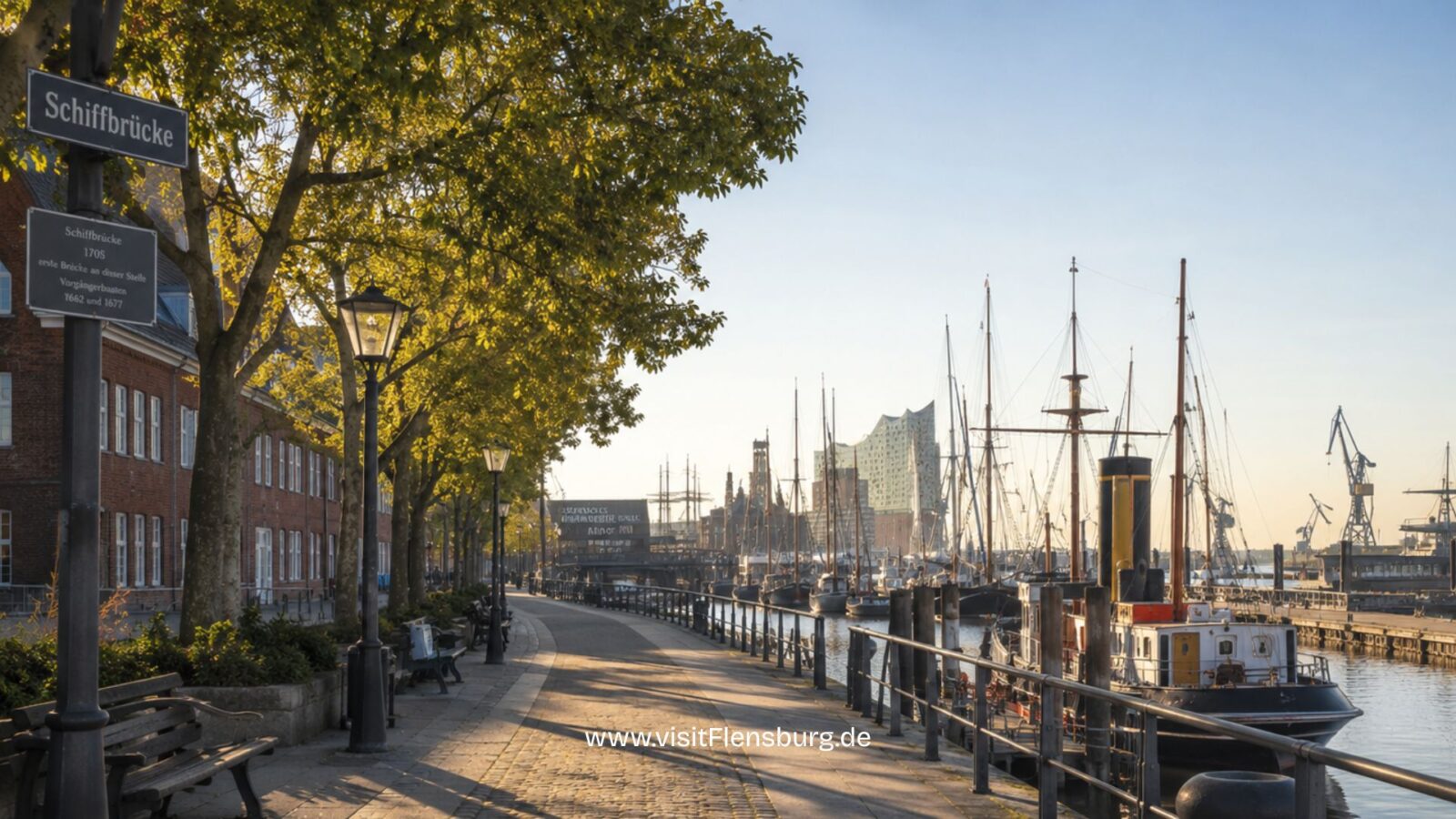
Before 8am, the harbour at Flensburg is quiet enough that you can hear the ropes creak. The old wooden vessels in the Museumshafen shift slightly against their moorings, the Förde sits flat and grey, and the first light catches the painted facades of the former trading houses along Schiffbrücke in shades of cream and ochre.
By 10am it looks completely different. Café chairs scrape the cobbles, tour groups gather near the Schifffahrtsmuseum, and the wooden dock smells of coffee and salt and, faintly, of the old rum cellars beneath the waterfront buildings. If you want to see what Flensburg’s harbour is actually about, both versions are worth knowing.
This guide covers everything worth seeing, eating, and doing along Schiffbrücke — the long quayside promenade that runs the full length of the historic harbour — along with a few things most visitors walk straight past.
This post contains affiliate links. If you book through them, we may earn a small commission at no extra cost to you.
What Is Schiffbrücke?
Schiffbrücke is the name of both the street and the concept — the historic mooring point of the city’s merchant sailing fleet. The word translates literally as “ship’s bridge,” and for several centuries that is exactly what it was: a long wooden jetty where cargo from the Caribbean, Scandinavia, and the Mediterranean came ashore to be weighed, taxed, and moved into the warehouses that still stand along the quay.
The street runs roughly north to south along the western edge of the harbour, with the water and moored vessels on one side and former merchant buildings, warehouses, and the occasional gap leading up into the old town on the other. The full length is about 800 metres. Most visitors walk half of it, turn around at the Schifffahrtsmuseum, and miss the upper section completely.
The harbour has been the economic anchor of Flensburg for over 700 years. Before Copenhagen and after Hamburg, it was one of the Danish kingdom’s most important trading ports — a status it held from the medieval period through to the 19th century. The buildings that survive along Schiffbrücke are, for the most part, the direct physical evidence of that period: warehouses, rum houses, merchant courtyards, and the old customs house that now holds the maritime museum.
Walking the Harbour: North to South
The most logical way to walk Schiffbrücke is from north to south, starting at the upper end near the Nordertor area and finishing at the Schifffahrtsmuseum and Museumshafen at the harbour’s southern tip. This puts the wind at your back on colder days and saves the most visually striking section for the end.
The Upper Harbour — Schiffbrücke 1 to 30
The northern section of Schiffbrücke is quieter and less photographed than the museum end. The buildings here are a mix of periods — 18th-century merchant houses sitting alongside 20th-century rebuilds — and the waterside here is accessible rather than performative. A few small boats are moored along the embankment; there is usually a fisherman or two.
This is also where some of the best eating on the harbour happens, in restaurants and cafés that sit slightly under the tourist radar. The Hafenküche, a no-frills spot focused on fresh fish, regularly earns better reviews than the more prominent restaurants further south. Worth keeping in mind if you want lunch without the wait.
At Schiffbrücke 16, the building now occupied by Hansens Brauerei was, from 1781 to the late 1990s, the home of Rumhaus Sonnberg — one of the city’s major rum producers. The building dates from the 18th century, retains its original steep saddle roof construction, and is a listed cultural monument. When Hansens Brauerei relocated here in 2000, it moved into a genuine piece of Flensburg’s commercial history. The copper brewing equipment is visible from the main bar, the terrace faces directly onto the water, and the food — particularly the rotisserie chicken — is considerably better than brewery pub food usually is. Opening hours run Monday to Thursday 11:30–01:00, Friday and Saturday 11:30–02:00, Sunday 11:30–midnight.
The Middle Harbour — Schiffbrücke 30 to 50
This is where Schiffbrücke opens up. The quayside widens, the views across the Förde become clearer, and the density of things worth stopping at increases considerably.
The Werft-Café at Schiffbrücke 43–45 is one of the better places on the harbour for coffee and a slower hour. It sits directly across from the Museumswerft — the museum shipyard — and the view from the outdoor tables is of working boatbuilders and traditional vessels in various states of reconstruction. The Museumswerft’s craftspeople work from historical plans on sailing ships and working boats typical of the Baltic region 100 to 200 years ago. Watching them from across the water over a coffee is not a bad way to spend 45 minutes.
The Rum Kontor at Schiffbrücke 39 belongs to the Schifffahrtsmuseum — it is the retail and tasting arm of the maritime museum’s rum collection — and opens Tuesday to Sunday, 10:00–17:00. The shop stocks carefully selected rums from independent producers worldwide, with genuine depth in Caribbean and aged expressions. If you are planning to do the full rum tour in Flensburg, this is a sensible first stop before heading to Braasch and Johannsen.
The Lower Harbour — Museumshafen and Schifffahrtsmuseum
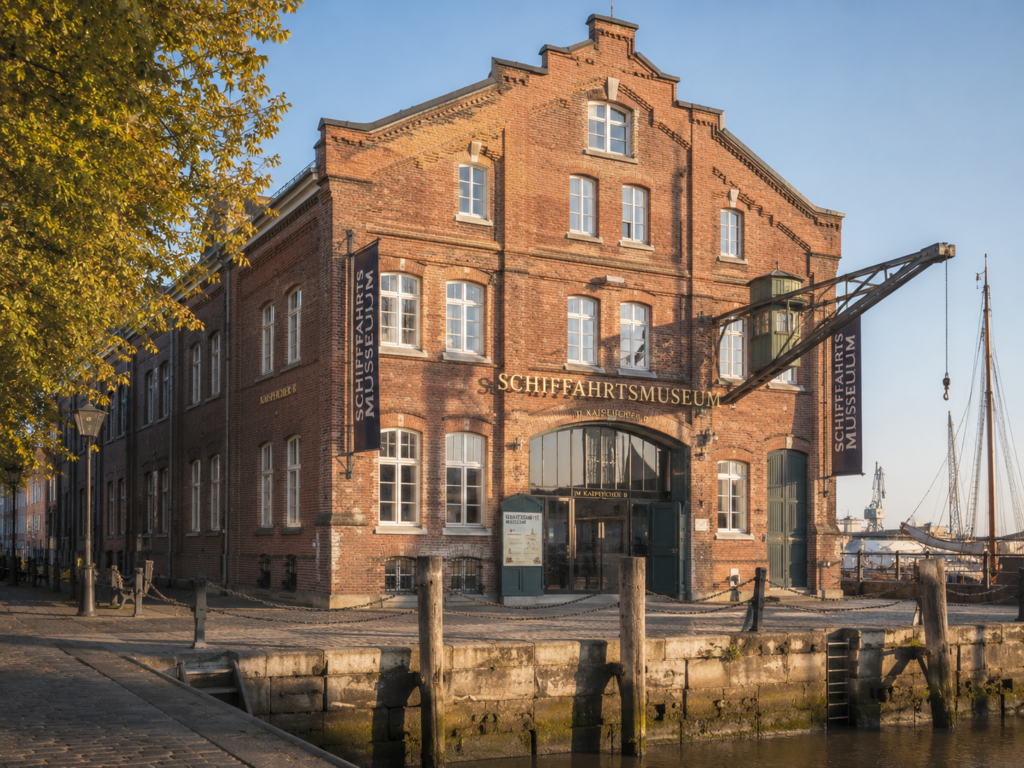
The southern end of Schiffbrücke is where the harbour concentrates into something you can genuinely linger over for an hour.
The Museumshafen — the museum harbour — is a private initiative that has been running since it was founded in 1979. The organisation was established as a non-profit in the Gasthaus Schwarzer Walfisch in 1979, with the aim of restoring and maintaining traditional sailing vessels and historical watercraft, specifically the small cargo sailers of the regional coastal trade. Around 20 traditional wooden vessels are moored here permanently. They are not static exhibits — the boats are maintained, sailed, and used for events including the annual Rum Regatta in May and the Apfeltörn in October.
You can walk the wooden jetty freely at any time. There is no admission charge to look, and the boats are moored closely enough that you can read their names and origins from the dock. What the Museumshafen does that most maritime museums don’t is show you vessels that are genuinely seaworthy rather than preserved behind glass. The Alexandra — Germany’s last sea-going coal-fired steamship — runs harbour tours from May to October. She was built in 1908 and is still maintained by a dedicated association. A cruise on the Förde in a 100-year-old steam vessel is one of the more unusual things you can do in this part of Germany.
The Schifffahrtsmuseum itself sits in a building constructed in 1842–43 as the royal Danish customs warehouse. The former customs house was built to designs by the royal Danish building inspector Meyer, and was used to store bonded goods for Flensburg merchants — rum being one of the principal products — until 1972. The state of Schleswig-Holstein handed it to the city in 1979, which converted it into the maritime museum. The rum cellar in the basement is still worth the admission price on its own — the smell of the oak barrels has genuinely never left the walls.
The Rum Museum downstairs covers the full arc of the city’s Caribbean trade. Admission to the Schifffahrtsmuseum is €6 for adults. Allow 90 minutes if you plan to take it properly rather than rushing through.
What to Eat on Schiffbrücke
The eating options along the harbour range from excellent to tourist-trap, and the two are not always easy to tell apart from the outside. A few honest recommendations:
Hansens Brauerei — Schiffbrücke 16
The brewery pub in the former Rumhaus Sonnberg is the most atmospheric restaurant on the harbour and reliably good. The menu covers German standards — schnitzel, roast meats, salads — with a few seasonal specials. The Hansens Pilsener is brewed on the premises, and the Hansens Schwarzbier is dark and well-rounded. In summer, the terrace facing the water is one of the better outdoor eating spots in the city.
Hafenküche — Upper Schiffbrücke
A smaller, less decorated fish restaurant in the northern section of the quay. The menu changes depending on what is fresh, the portions are substantial, and the prices are more honest than the waterfront location might suggest. No advance booking, so arrive early for lunch.
Fischbude — Lower Harbour Area
A fish counter near the museum harbour end, serving fried fish, smoked herring, and sandwiches from a small stand. Not a sit-down restaurant — eat at the harbour wall. The herring is the thing to order.
Columbus Genusswirtschaft
Slightly inland from the waterfront but within easy walking distance, Columbus is better for a longer evening meal. German-European menu, reasonable wine list, and genuinely attentive service. One of the restaurants that regularly appears at the top of Flensburg dining lists for good reason.
Coffee
The Werft-Café at Schiffbrücke 43–45 for the view. ISA Café & Eis on the upper harbour for something smaller and quicker. Both are worth knowing.
What to Do on the Harbour
Beyond walking and eating, the harbour has several things worth building time around:
Boat trips on the Alexandra. The 1908 steam paddle ship runs scheduled trips along the Flensburg Firth between May and October. The route goes south toward the Danish shore and back. Duration is roughly two hours. Check the association’s website for the current season schedule before you go — trips run on specific days rather than daily.
The Kapitänsweg walking trail. A self-guided route that begins at the Schifffahrtsmuseum and follows the harbour and old town using brass steering-wheel markers set into the pavement. 14 information boards give explanations of the various buildings in German and Danish, and the trail traces the typical path of a 17th-century sea captain through the city. An introductory brochure is available from the museum. The full route takes about 90 minutes at a comfortable pace.
The Museumswerft. The working shipyard on the eastern bank accepts visitors. Watching the boatbuilders work on traditional timber vessels using historical construction methods is the kind of thing that sounds niche and turns out to be genuinely absorbing for anyone with even a passing interest in how things are made.
Harbour tours with GetYourGuide. If you want a guided experience of the harbour and old town rather than navigating it alone, tours run from Flensburg covering the waterfront, the rum history, and the merchant courtyards. Check available harbour tours →
The Rum Regatta. Every May, the Museumshafen becomes the centre of one of Germany’s most unusual sailing festivals — over 200 traditional vessels gather on the Förde, and the prize goes not to the first ship to finish, but the second. The Rum Regatta weekend turns the entire harbour into something quite different from its usual self. If you are visiting in late May, time your arrival to coincide with it.
The Harbour at Different Times of Day
The harbour changes character across the day in ways that are worth knowing if you are planning your time.
Early morning (before 9am) is when it is quietest and most photogenic. The light on the water and the facade colours along the quay are at their best. If you are a photographer, this is the only time worth setting an alarm for.
Late morning (10am–12pm) is when the museums open and the café terraces fill up. Good for a leisurely walk followed by a late breakfast at the Werft-Café.
Lunchtime is when the harbour is busiest — tour groups, day visitors, school trips. The restaurants fill up. If you want a table at Hansens without a wait, arrive before noon or after 2pm.
Late afternoon (4pm–7pm) is arguably the best general time to visit. The day visitors thin out, the light is golden, and the boats in the Museumshafen are visible in good light without the midday crowd. The Rum Kontor closes at 5pm, so factor that in if you want to visit.
Evening — the harbour is pleasant after dark in summer, with the brewery pub terrace running late and a few bars in the streets just above Schiffbrücke. It is never raucous; Flensburg’s nightlife is quieter than its harbour suggests.
Getting to the Harbour
Flensburg’s harbour is about 15 minutes on foot from the main train station (Flensburg Bahnhof), heading north through the old town and then down toward the waterfront.
By bus, the ZOB (central bus station) is a short walk from the harbour. Several routes stop near Schiffbrücke.
Parking is available in the city centre car parks, with the harbour-side car park near the Schifffahrtsmuseum being the most convenient. It fills up quickly on summer weekends, particularly during events. If you are driving, arriving before 10am or after 5pm avoids the worst of it.
If you are basing yourself in the city, hotels in Flensburg cluster around the city centre and the waterfront. Hotel Hafen Flensburg sits directly on Schiffbrücke at number 33 — you could not be closer to the harbour without sleeping on a boat.
For a day trip from Flensburg to Denmark, the harbour is a logical starting point — the road north begins just a few minutes from Schiffbrücke and the border is 20 minutes away by car.
Beyond the Harbour: What’s Close By
The harbour connects naturally to everything else worth seeing in Flensburg. The Nordertor Gate — the medieval arch at the top of Norderstraße — is a 10-minute walk uphill from the northern end of Schiffbrücke, through the pedestrianised old town. The Museumsberg sits on the hill above and to the east of the harbour, about 15 minutes on foot through the streets behind Rote Straße.
Glücksburg Castle is 10 kilometres east along the fjord — a 15-minute drive from the harbour car park. It is the most visited day trip from the city and fits neatly into a morning before a harbour lunch.
For a full picture of what to do in Flensburg, the attractions guide covers all six main sites with practical details and opening hours.
How long should I spend at Flensburg Harbour?
A minimum of two hours covers the Museumshafen, a walk along Schiffbrücke, and a coffee stop. Add another hour if you are going into the Schifffahrtsmuseum and rum cellar, and another 90 minutes for the Kapitänsweg trail. A full morning or afternoon is not too long if you plan to eat on the quay.
Is Flensburg Harbour free to visit?
The quayside walk along Schiffbrücke is completely free, as is the Museumshafen jetty. Admission to the Schifffahrtsmuseum is €6 for adults. The Rum Kontor shop is free to browse. The Museumswerft accepts visitors without charge. Boat trips on the Alexandra are ticketed — check the current season schedule for prices.
What is the Museumshafen in Flensburg?
The Museumshafen is a museum harbour maintained by a private non-profit association, founded in 1979. Around 20 traditional wooden sailing vessels are moored here permanently — small Baltic cargo sailers, fishing boats, and historic craft — all kept in seaworthy condition. The jetty is open to walk at any time. The boats are used for events including the Rum Regatta in May and the Apfeltörn apple-trading festival in October.
What is Schiffbrücke in Flensburg?
Schiffbrücke is the historic quayside promenade that runs the length of Flensburg’s harbour. The name means “ship’s bridge” — it was originally the main mooring point for the city’s merchant fleet. Today it is a pedestrian waterfront street lined with former trading houses, restaurants, the Schifffahrtsmuseum, and the Museumshafen. It is about 800 metres long from its northern end to the museum at the southern tip.
What is the best restaurant at Flensburg Harbour?
Hansens Brauerei at Schiffbrücke 16 is the most atmospheric option — it occupies a listed 18th-century former rum house and has a large terrace facing the water. For fish, the Hafenküche in the upper harbour section offers honest seafood without the waterfront markup. The Fischbude near the museum harbour is worth knowing for a quick smoked herring and a harbour wall lunch.
When is the best time to visit Flensburg Harbour?
Early morning for photographs and atmosphere, late afternoon for visiting without crowds. Late May is the best single weekend — the Rum Regatta brings over 200 traditional sailing vessels into the Museumshafen, and the harbour turns into something quite extraordinary for a few days. Summer (June–August) has the best weather for the terrace restaurants and the Alexandra boat trips.