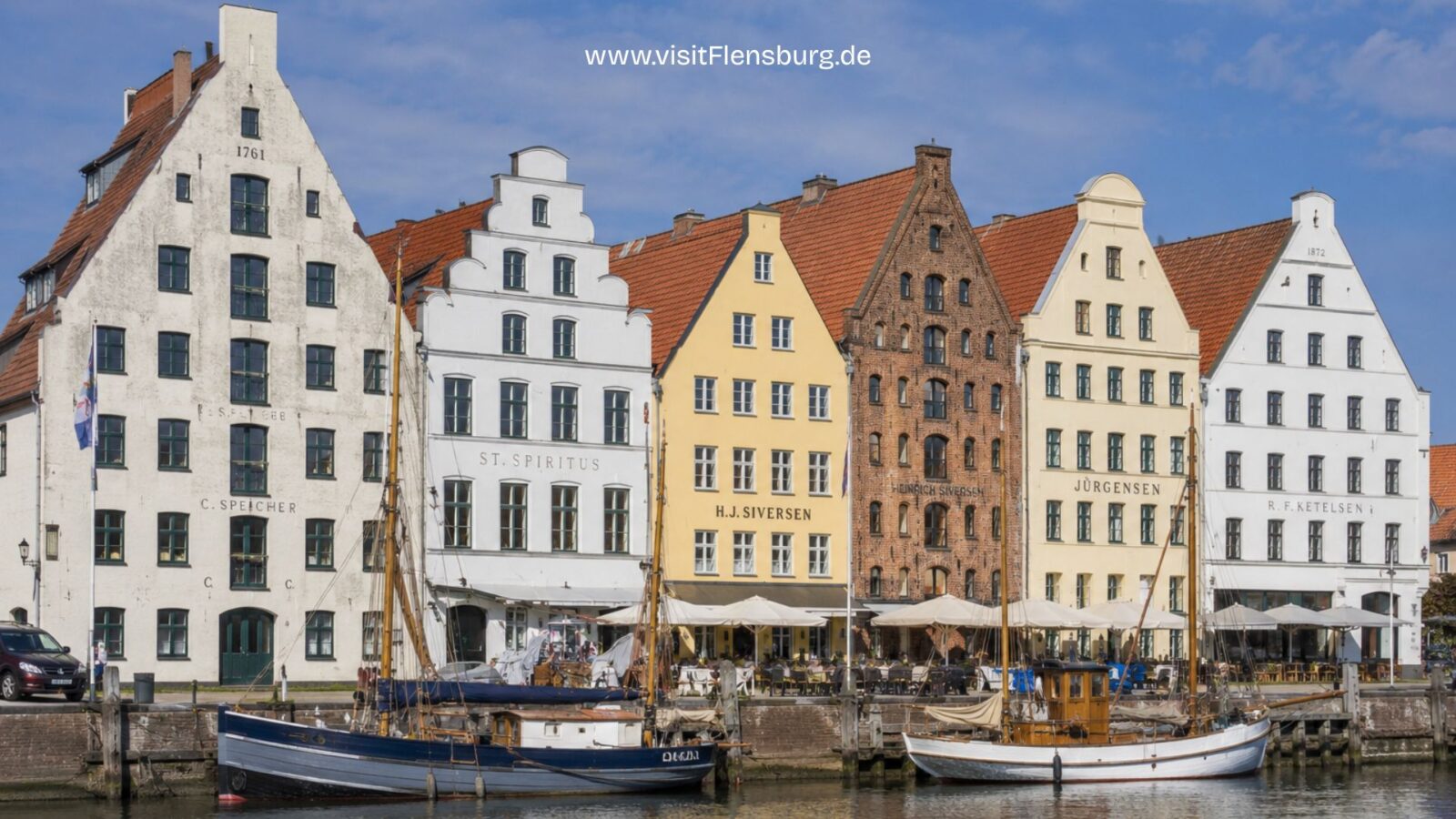
The cellar of the Schifffahrtsmuseum still smells of rum. Not faintly — properly, the way an old oak barrel does when you press your nose close. That smell has been in the walls of the building since the 18th century, when it was a customs warehouse on the harbour and casks of Jamaican rum sat stacked floor to ceiling, waiting to be counted, taxed, and sold north across Scandinavia.
That is the smell of Flensburg’s most unlikely legacy. Germany is not the country most people associate with rum. And yet this city — sitting on a fjord in the far north, closer to Copenhagen than Hamburg — was once the rum capital of Europe. At the height of the trade, more than 60 rum producers operated within the city limits. The surrounding merchant courtyards were built on the profits. The harbour ran with it.
Today, only a handful of the old rum houses remain. But the story they carry is more than worth a half-day of your time. This guide covers everything you need to know about the rum tour in Flensburg — the history, the venues, what to taste, and how to put a route together.
Why Flensburg Became Germany’s Rum City
The short answer: a ship called the Neptunus, a Danish royal charter, and a very long sea route.
In 1755, the Neptunus left Flensburg harbour on the first direct voyage from the city to the Danish West Indies — the islands of St. Croix, St. Thomas, and St. John in the Caribbean, which were then Danish colonies. On the return journey, the ship carried cotton, tobacco, sugar, and rum. Nobody at the time knew that this single voyage would shape the city’s identity for the next 270 years.
Flensburg was then part of the Kingdom of Denmark, and the charter granted its ships access to the same Caribbean trade routes that had made Copenhagen and Altona wealthy. The city already had experience in spirits — distillers had been producing brandy here for generations. Rum was a natural extension. By the early 1800s, Flensburg was importing more than one million litres of Caribbean rum per year from St Croix, St Thomas, and St John alone. The merchant courtyards along the Holm, Große Straße, and Norderstraße filled up with Rumhäuser — rum trading houses — whose owners became some of the wealthiest people in northern Europe.
Then, in 1864, the political ground shifted. Prussia and Austria defeated Denmark in the Second Schleswig War, and Flensburg was absorbed into the German state. Overnight, the city lost access to the Danish Caribbean trade routes that had supplied its rum industry for over a century. The Rumhäuser adapted fast. They turned to Jamaica — a British colony whose high-ester rums proved, if anything, better suited to blending than the Danish West Indian variety. The trade continued.
The next crisis came from taxation. In 1885, the German Empire introduced the Reichsmonopolgesetz, a law that sharply increased import duties on rum. Faced with the choice between higher prices and lower margins, Flensburg’s rum producers invented something new: Rum-Verschnitt. The method was simple and clever. A small proportion of genuine Jamaican overproof rum — just 5% was the legal minimum — was blended with neutral domestic grain spirit and water. The result was drinkable, affordable, and distinctly Flensburg. Around 30 firms produced it. The blend has been sold across Germany and into Scandinavia for generations.
The 20th century was harder. Two wars, the 1948 currency reform, and eventual market consolidation hollowed out the industry. The last major industrial producer — Hermann G. Detleffsen — was taken over by Berentzen in 1998, ending the era of large-scale rum production in the city. What survived were two small, family-run operations: A.H. Johannsen, founded in 1878, and Braasch, both of which still make rum in Flensburg today. Together with the Rum Museum inside the Schifffahrtsmuseum and the Rum Kontor on Schiffbrücke, they form the backbone of any proper rum tour of the city.
The Rum Tour Route: Where to Go
A rum tour of Flensburg has four main stops. You can do all of them in a single afternoon, or spread them across a morning and evening if you want to take your time between tastings. The route runs logically from the harbour northward through the old town, finishing near the Nordertor.
Stop 1 — The Rum Museum (Schifffahrtsmuseum), Schiffbrücke 39
The best place to start is the Rum Museum in the basement of the Schifffahrtsmuseum — the maritime museum — right on the harbour at Schiffbrücke 39. This is the former customs warehouse where the Jamaican rum casks were stored when they arrived by ship, and the building has barely changed in its proportions since the 18th century.
The museum tells the story of the Flensburg rum trade through original equipment, archive documents, and a multimedia presentation that follows the merchant Andreas Christiansen — a real historical figure — from his arrival in Flensburg in 1755 to his death in 1813 as the wealthiest man in the city. The Caribbean trade routes are shown alongside the shadow side of that wealth: the slave trade that made the sugar plantations of St Thomas and St Croix productive in the first place. The museum does not look away from this, which makes it more honest than many heritage presentations of a similar vintage.
Upstairs, the Rum Kontor is a specialist shop attached to the museum, stocked with an unusually good selection of rums from around the world. The staff know their product, and a short tasting is often possible if you ask. The Kontor opens Tuesday to Sunday, 10:00–17:00. Admission to the Schifffahrtsmuseum is required to access the rum cellar.
The Rum Museum is one of the most specific and genuinely interesting museum experiences in northern Germany. An hour here is time well spent before you walk further into the city.
Stop 2 — Braasch Rum Manufaktur Museum, Rote Straße 26–28
A ten-minute walk north from the harbour along Rote Straße brings you to Braasch. The building sits on one of the prettiest streets in Flensburg’s old town — a narrow, coloured-house street that has more in common with a Danish market town than a German city — and the Braasch premises occupy a traditional Kaufmannshof, one of the merchant courtyard complexes that made this neighbourhood wealthy in the 18th century.
Braasch is both a working rum producer and a small museum. The manufacturing side — what they call the Rum Manufaktur — is visible through glass, and the museum section explains the production process in detail. Unlike the Schifffahrtsmuseum’s historical angle, Braasch focuses on the making: how raw Jamaican rum arrives, how it is blended and aged, and what makes a Flensburg Rum-Verschnitt distinct from other blended spirits.
The tasting room is the reason most people come. Braasch’s own rum range includes several aged expressions and liqueur variations, and the shop attached to the museum stocks them alongside bottles from other producers. The staff are enthusiastic and will walk you through the range if you ask. Prices in the shop are reasonable by specialty rum standards.
The museum is free to enter, which is unusual and worth noting. The shop and tasting are the commercial elements, and neither feels pushy. Braasch is a family business run by Walter and Karsten Braasch, and the atmosphere of the place reflects that — small, knowledgeable, and genuinely interested in the subject rather than performing enthusiasm for tourists.
Opening hours vary seasonally, so check before you go. The shop at Große Straße has longer hours if you miss the museum.
Stop 3 — A.H. Johannsen, Marienstraße 6–8
Johannsen is the oldest surviving rum house in Flensburg, founded in 1878, and the only producer still making traditional Rum-Verschnitt in the city. The address is Marienstraße 6–8, a few minutes from Rote Straße, heading slightly uphill from the old town centre.
The guided tours here run approximately 90 minutes and cover the history of the company, a walk through the production space, and a tasting of rum and liqueurs. The guide — reportedly often someone called Frau Petersen, based on visitor accounts — takes a relaxed, well-informed approach and handles the historical material in a way that is entertaining without glossing over the complexity of the trade’s origins. Reviews from visitors describe the tour as genuinely interesting rather than a sales pitch.
Tours at Johannsen need to be booked in advance. Group tours for six or more can be arranged for private dates; individual visitors should check the schedule on the Johannsen website for open tour slots. The cost is modest — around €6.50 per person based on recent visitor reports, though prices should be confirmed directly with Johannsen before you book.
The shop — called the Hökerei — is open without a tour and stocks the full Johannsen range, including the Rum Regatta Rum (bottled annually), the 1878 blend, and the Wind Force 13. If you are buying just one bottle to take home, the 1878 Rum-Verschnitt is the most historically representative choice.
Booking a guided tour at Johannsen is one of the best ways to spend an afternoon in Flensburg. You can also browse Flensburg rum experiences on GetYourGuide if you prefer a guided city walking tour that includes the rum history alongside the wider harbour and old town.
Stop 4 — Rum Kontor Flensburg, Schiffbrücke 39
If you started at the Schifffahrtsmuseum and want to finish with a purchase rather than just a tasting, the Rum Kontor at Schiffbrücke 39 is the specialist retailer most closely linked to Flensburg’s rum heritage. It opens Tuesday to Sunday, 10:00–17:00, and stocks a carefully selected range of rums from producers worldwide, with particular depth in Caribbean and aged expressions.
This is not a tourist shop with branded shot glasses. The Kontor’s buyers take it seriously, and the selection reflects genuine curation. If you are looking for a bottle as a souvenir rather than a gift for someone who collects rum, ask the staff what they would recommend from local producers — the answer will be more useful than browsing the shelves alone.
The Rum Walking Tour: “Rum und Meer”
Beyond the individual stops, there is a structured walking tour called “Rum und Meer” (Rum and Sea) that covers the rum history of the city in one guided route. The tour starts at the Schifffahrtsmuseum, takes in the harbour, the Nordertor — which was the medieval gate at the top of the old trading street — and ends at the Johannsen rum house.
The tour is run by local guides, with Andrea Petersen being one of the regularly praised names among past visitors. Duration starts at 1.5 hours, with extensions available at 30-minute increments. English-language tours carry a surcharge of €30. The meeting point is arranged directly with the guide, typically in front of the Schifffahrtsmuseum.
The “Rum und Meer” tour is a good option if you want the history delivered with local context rather than reading the museum panels yourself. It also gives you access to details about the merchant courtyards and the social history of the rum trade that the individual venues don’t always cover in depth.
What Is Rum-Verschnitt and Should You Try It?
This is the question most visitors have when they first encounter the Flensburg rum tradition. Rum-Verschnitt sounds, on the surface, like a lesser product — a blend, a cut, a workaround. And in one sense it is: the original version was specifically designed to stretch a small amount of expensive Jamaican rum as far as possible using cheap domestic spirit.
But the finished product is more interesting than the method suggests. High-ester Jamaican rum — the kind used in Verschnitt production — is intensely aromatic, concentrated in a way that means even 5% of it in a blend carries real character. The Johannsen versions, in particular, have been refined over more than 140 years and have a quality that their somewhat industrial-sounding origin does not imply.
The comparison to understand is blended Scotch whisky. The base spirit in Rum-Verschnitt is neutral, just as the grain whisky in a blended Scotch is relatively neutral. What matters is the quality and proportion of the high-character component, and the skill with which the two are combined. Johannsen’s blenders know what they are doing.
Try it neat first. Then, if the flavour is interesting but the strength is too high for your preference, add a small amount of water. This is how the traditional German navy consumed it — the same grog tradition that made rum popular across northern Europe in the first place.
The Rum Regatta Connection
Every year in late May, Flensburg holds the Rum Regatta — a sailing festival that has been running since 1975 and now draws more than 200 traditional sailing vessels to the harbour. The connection to rum is built into the event’s structure: uniquely, it is the second ship to finish that wins the coveted prize — a three-litre bottle of rum. Coming first is, by design, the wrong result.
The Rum Regatta is one of the best times to visit Flensburg. The harbour fills with wooden-hulled gaff-rigged boats, the quayside at Schiffbrücke is crowded with sailors and spectators, and the rum houses do a roaring trade. If you are planning a rum-focused visit to the city, timing it around the Rum Regatta in late May gives you both the maritime atmosphere and the rum culture at the same time.
Where to stay in Flensburg during the Regatta weekend should be booked well in advance — the festival draws visitors from across Germany and Scandinavia, and accommodation fills quickly.
Practical Information for the Rum Tour
Starting point: Schifffahrtsmuseum, Schiffbrücke 39, Flensburg End point: Johannsen, Marienstraße 6–8 (or Rum Kontor if you want to finish on the harbour) Total walking distance: Around 1.5 km — the route is compact and entirely flat Time required: Half a day for all four stops (3–4 hours with tastings); a full afternoon if you do a guided tour at Johannsen
What to eat: The rum culture and the food culture overlap at the Handelshöfe — the merchant courtyard cafés on Rote Straße and around the Holm. A few serve rum-based food, including rum cake and rum ice cream, which are local specialities that sound gimmicky but are genuinely good.
Driving and parking: The old town is compact and best on foot. If you are driving, park at the harbour car park near the Schifffahrtsmuseum and walk the route from there. See the car rental in Flensburg guide if you are arriving by car and need to arrange a vehicle.
Season: The rum venues are open year-round, though Johannsen tours require booking, and Braasch hours vary in winter. The harbour walk is best in good weather, but the museums are indoors and perfectly suited to a grey afternoon.
Age restriction: You need to be 18 or over to participate in tastings. This is strictly observed in Germany.
Beyond the Rum Tour: What Else to See Nearby
After the rum route, the rest of Flensburg’s old town is within easy walking distance. The Nordertor Gate — the medieval north gate of the city, built in 1595 — stands at the top of Norderstraße and marks the former boundary of the walled town. It is about a five-minute walk from Johannsen and is worth a photograph even if you don’t stop.
The Flensburg Harbour — Schiffbrücke — is where you started, and it is worth a second pass in the late afternoon when the light on the water changes and the boats at the Museumshafen are visible from the quayside. The museum harbour, which sits just south of the Schifffahrtsmuseum, keeps a collection of traditional working vessels that have been restored by a private initiative. The boats are often crewed on summer weekends.
For a full picture of what to do in Flensburg beyond the rum tour, the attractions guide covers all the main sites with practical details.
What is the Flensburg rum tour?
The rum tour in Flensburg is an informal self-guided or guided route through the city’s rum heritage. It takes in the Rum Museum in the Schifffahrtsmuseum on the harbour, the Braasch Rum Manufaktur Museum on Rote Straße, the A.H. Johannsen distillery on Marienstraße, and the Rum Kontor on Schiffbrücke. A guided walking tour called “Rum und Meer” is also available through local tour operators. The full route covers about 1.5 kilometres and takes around 3–4 hours with tastings.
How do I book a rum tour in Flensburg?
The Johannsen guided tour requires booking through the Johannsen website at johannsen-rum.de. Open tours run on scheduled dates; private group tours for six or more can be arranged separately. The “Rum und Meer” walking tour is bookable directly with the local guide. For tours and experiences bookable online, GetYourGuide lists available Flensburg options, including rum-focused experiences.
What is Rum-Verschnitt, and how is it different from regular rum?
Rum-Verschnitt is a Flensburg specialty: a blend of a small proportion of genuine Jamaican overproof rum — a minimum of 5% by law — with neutral domestic grain spirit and water. The high-ester Jamaican rum used in blending is intensely aromatic, and even a small proportion carries real character in the finished product. Think of it as comparable to blended Scotch whisky, where the quality of the character component matters more than its volume in the blend. Flensburg producers have been refining the method since the 1880s.
Is the Rum Museum in Flensburg free?
The Braasch Rum Manufaktur Museum on Rote Straße is free to enter. The Rum Museum inside the Schifffahrtsmuseum requires admission to the maritime museum, which covers the full building, including the rum cellar. The Rum Kontor shop at Schiffbrücke 39 is open to browse without charge.
When is the best time to visit Flensburg for rum tourism?
The rum venues are open year-round, so any time of year works for the museum and distillery visits. Late May is the best time if you want to combine the rum history with the Rum Regatta, Flensburg’s annual traditional sailing festival, which draws over 200 historic vessels to the harbour. Summer (June–August) brings the best weather for walking the harbour route. Winter visits are quieter, but the museums are fully operational, and Johannsen tours run throughout the year, subject to booking.
Why is Flensburg called Germany’s rum capital?
Flensburg earned the name Rumstadt (Rum City) through its 18th and 19th-century role as the primary German import and blending centre for Caribbean rum. When the ship Neptunus first sailed from Flensburg to the Danish West Indies in 1755, it started a trade that eventually saw more than 60 rum producers operating in the city. At the height of the trade, Flensburg handled around 70% of Germany’s rum business. Today, Johannsen and Braasch carry that tradition forward — smaller in scale, but direct descendants of the original merchant houses.