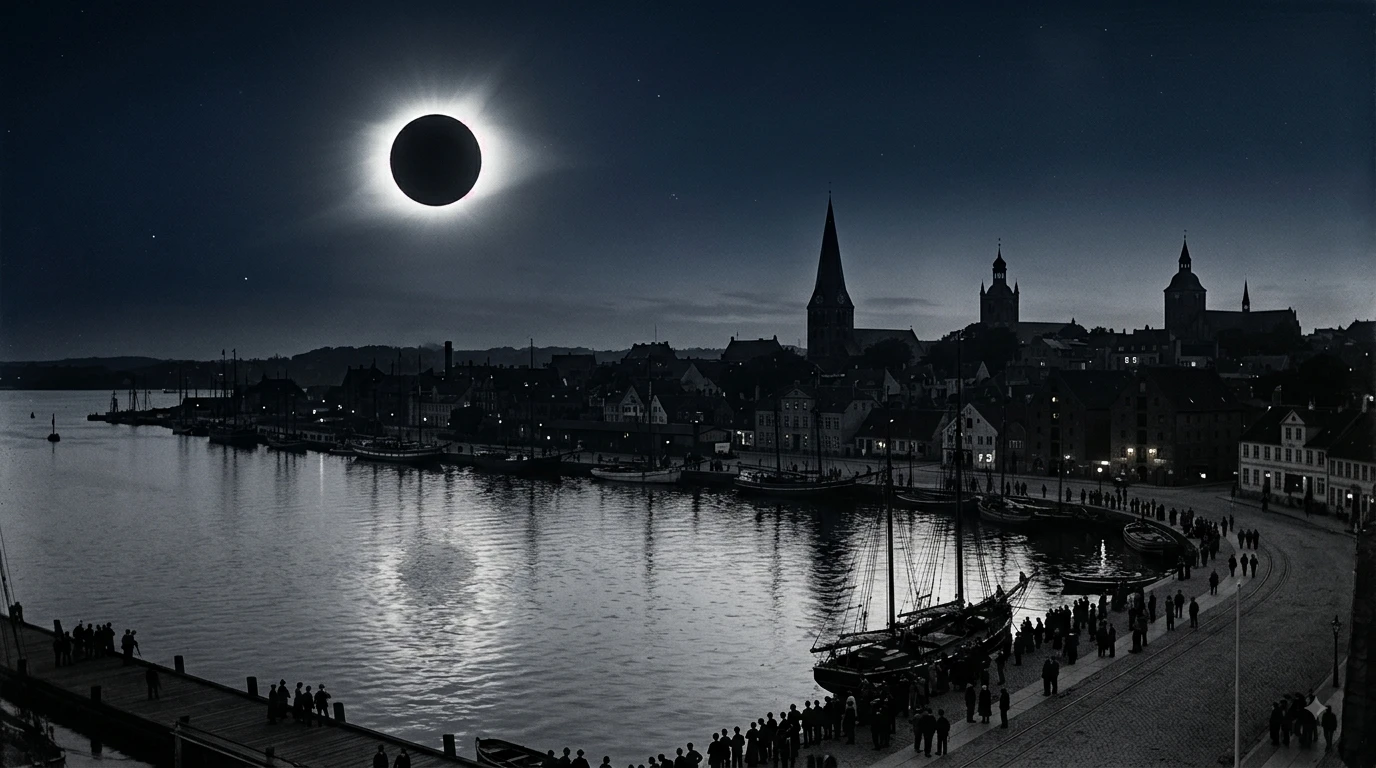
At about 19:11 this evening, the moon starts eating into the western edge of the sun, and by ten past eight roughly 85% of it is gone. Nothing like this has been visible from northern Germany since August 1999. Nothing like it will be visible again until 2075, which is a long enough wait that most of us should probably go outside tonight.
One catch, and it’s a big one: the sun will be sitting very low over the west-north-west horizon the entire time. In a city built on two steep slopes either side of the water, that changes everything about where you stand.
What Flensburg sees tonight
This is a partial eclipse here, not a total one. The moon’s dark inner shadow passes over Greenland, Iceland and northern Spain, several hundred kilometres of Atlantic away from Schleswig-Holstein. What we get is the outer shadow, and it is still the deepest bite out of the sun in a generation.
Rough timings for Flensburg, all in local time (CEST):
- 19:11 — first contact. The moon’s edge touches the sun. You won’t notice a thing without eclipse glasses.
- 20:05 — maximum. Around 84–85% of the solar disc is covered here in the far north. Freiburg and Konstanz get closer to 90%; we’re at the shallower end of the country, though honestly the difference is invisible to the eye.
- 21:04 — sunset. The last act plays out right down at the horizon, in that orange, thickened light you get over the Förde in August.
Times shift by a minute or two depending on exactly where you’re standing. If you want it to the second for your spot, timeanddate.com will calculate it.
Where to stand: the horizon matters more than the sky
Here’s the part most eclipse guides skip. At maximum the sun sits only a few degrees above the horizon. That means one hedge, one apartment block or one line of beech trees to your west and you lose the whole thing, even under a perfectly clear sky.
Flensburg’s old town sits in the bottom of the valley. Stand on the harbour at eight in the evening and you are looking straight into the western hillside, rooftops and all. Beautiful spot, wrong direction tonight.
Go west and go up. The high ground on the western side of the city — the Museumsberg, the streets climbing towards Westliche Höhe, the open edges of the Volkspark — puts you above the roofline with the horizon in front of you rather than above you. Better still, get out of the city entirely. The farmland running west towards Harrislee and the Danish border is flat, open and about ten minutes away by car, and the fields there give you a clean line all the way down to the ground.
The border itself is worth remembering. You can be across in Denmark in a quarter of an hour, and the open country around Kruså and Padborg has the same unobstructed western skyline. Same eclipse, different passport stamp, no stamp required.
I’ll be straight with you: I can’t promise any single spot works. Scout it before 19:00. Stand where you plan to stand, look west-north-west, and if you can see the actual horizon line, you’ve found it.
How to look at it without damaging your eyes
This is not the section to skim. Even with 85% of the sun hidden, the remaining sliver is bright enough to burn your retina, and it does it painlessly. You feel nothing while it happens and notice days later.
- Certified eclipse glasses only, marked ISO 12312-2. Sunglasses are not eclipse glasses. Neither are two pairs of sunglasses, smoked glass, exposed film, or a welding mask below shade 14.
- Check your glasses for scratches or pinholes before use. If light gets through anywhere it shouldn’t, bin them.
- No binoculars, telescopes or camera lenses pointed at the sun unless a proper solar filter is fitted over the front, not the eyepiece. Focused sunlight will melt through a filter placed behind the lens in seconds, with your eye directly behind it.
- Pinhole projection is free and completely safe. Punch a small hole in card, hold it up, let the sunlight fall onto a second sheet of card, and watch the crescent appear. A kitchen colander does the same trick and produces dozens of crescents at once. Kids love it more than the glasses.
Chemists, opticians and bookshops around the Holm were selling eclipse glasses in the run-up. If you’re reading this on the day and have nothing, the colander is genuinely your best option.
What 85% actually feels like
Manage your expectations, because the percentage misleads people. The sun is so overwhelmingly bright that removing 85% of it still leaves plenty. Streetlights won’t come on. Stars won’t appear. There is no sudden night.
What you get instead is subtler and stranger. The light goes slightly metallic, like an old photograph. Shadows sharpen at the edges. The temperature drops a degree or two, which you’ll feel more than you expect down by the water. Gulls get restless. And if you find a leafy tree, the gaps between the leaves act as thousands of tiny pinhole cameras and scatter crescent suns across the pavement. That, for my money, is the best thing about a deep partial eclipse.
Stay out for the Perseids
Tonight’s second gift: the new moon falls at 19:37, within half an hour of the eclipse maximum, and the Perseid meteor shower peaks over the night of 12–13 August. No moonlight at all. That is close to the best combination of circumstances you can ask for.
Walk away from the harbour lights, lie back somewhere facing north-east, and give your eyes twenty minutes to adjust. The coast north of the city and the fields towards the border are dark enough to make a real difference.
If you’re visiting rather than local, this is the argument for not driving home at ten. Rooms in the centre put you within walking distance of the old town in the morning SEE HERE and read our honest rundown of where to stay if you’d rather pick carefully than quickly.
If the cloud wins
It might. August skies over Schleswig-Holstein are unreliable at the best of times, and a low sun means you’re looking through the thickest, haziest slice of atmosphere available. Cloud along the western horizon is the single likeliest way this evening goes wrong.
If it does, there are worse consolation prizes than an August evening in this city. The observatories in Spain and Iceland will be streaming totality live, so you can watch someone else’s clear sky over a Flensburger. Then walk it off through the cobbled lanes of the old town, which stay open and lit long after the sun has gone. If you’d rather have a plan for tomorrow, SEE guided harbour walks and boat trips run right through the summer and don’t depend on the weather doing anything clever.
What time is the solar eclipse in Flensburg?
It begins at roughly 19:11 CEST, reaches maximum around 20:05, and continues down to sunset at 21:04. The whole thing plays out low in the west-north-west, so you need a clear horizon in that direction to follow it from start to finish.
How much of the sun will be covered in Flensburg?
Around 84–85% at maximum. Coverage increases towards the south-west of Germany, reaching close to 90% around Freiburg and Lake Constance, but the visual difference between 85% and 90% is small.
Is the eclipse total in Flensburg?
No. Totality is limited to a narrow track across Greenland, Iceland, northern Spain and the Balearics. Flensburg sees a deep partial eclipse, which is a genuinely different experience — the sky never goes dark and the corona is not visible.
Can I watch it with sunglasses?
No, and this matters. Only eyewear certified to ISO 12312-2 is safe for looking directly at the sun. Sunglasses, smoked glass and camera viewfinders all let through enough infrared and ultraviolet to damage your retina without any pain to warn you. Pinhole projection onto card is free, safe and works for a whole group at once.
Where’s the best place in Flensburg to watch it?
Anywhere with an unobstructed view down to the western horizon. The high ground on the western side of the city works better than the harbour, which faces into the hillside, and the open farmland towards Harrislee and the Danish border is the safest bet of all. Scout your spot before 19:00.
When is the next solar eclipse in Germany?
2 August 2027, though that one covers only about half the sun from Germany. For anything as deep as tonight, you’re waiting until 2075, and for an actual total eclipse over central Europe, 2081.