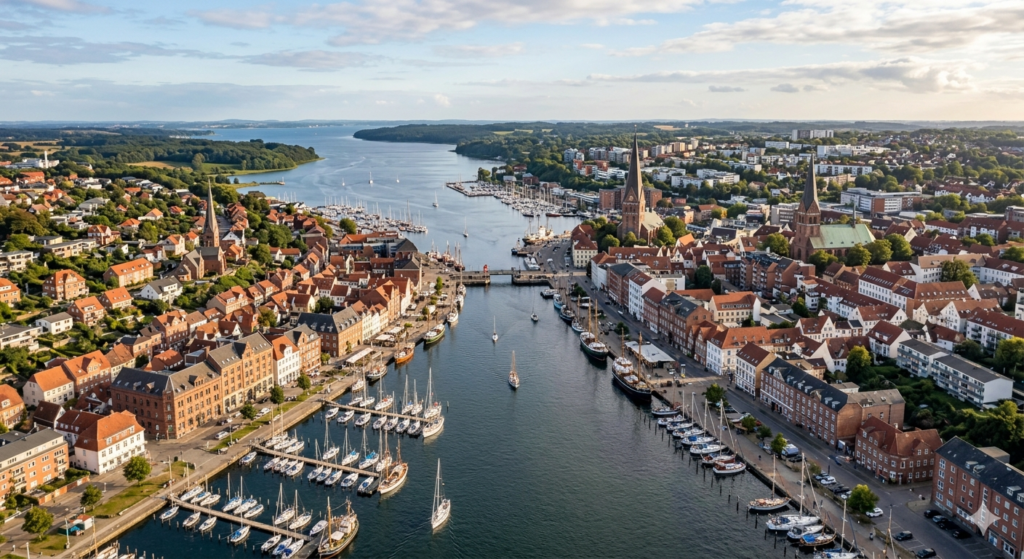
Flensburg sits at the very top of Germany. Not almost at the top — at the top. Seven kilometres to the north, the road changes language on the signage and you are in Denmark. The Flensburger Förde, the narrow fjord that cuts inland from the Baltic Sea, forms the natural border between the two countries, and for centuries this city existed on both sides of it at once.
That geographical fact shapes everything about Flensburg. The harbour, the rum trade, the Danish-German bilingualism, the architecture that looks more like a Danish market town than a Prussian city — all of it traces back to the same waterway and the same contested border. You cannot understand Flensburg without understanding where it sits.
This page covers what the city actually is, what it is known for, and what you will find when you get here.
Where Is Flensburg?
Flensburg is in the state of Schleswig-Holstein, in the far north of Germany, on the western shore of the Flensburg Firth. The firth — a narrow inlet of the Baltic Sea — extends roughly 40 kilometres inland from the open water and forms the southern edge of the Danish border region.
By distance, Flensburg is 90 kilometres north of Kiel, 170 kilometres north of Hamburg, and 80 kilometres south of Copenhagen by road (slightly less by crow). The Danish border at Kruså is 8 kilometres from the city centre, and on a clear day you can see the Danish shore from the beaches along the Förde.
The city sits at 54.8°N — the same latitude as Moscow and northern Canada. The winters are cold and grey, the summers are long and bright. In June, daylight stretches past 10pm. In December, it is dark by 3:30 in the afternoon. Both extremes are worth knowing before you plan a trip.
Flensburg has a population of around 92,000, making it the fourth-largest city in Schleswig-Holstein after Hamburg, Kiel, and Lübeck. For a city its size it punches well above its weight in terms of what it has to offer visitors — the harbour, the rum history, the castle 15 kilometres to the east, the easy crossing into Denmark. It is a compact city that takes about 15 minutes to walk across, which is both its main limitation and its main appeal.
What Is Flensburg Known For?
Rum
This is the answer that surprises most people. Germany is not a country most visitors associate with rum. But Flensburg was once the rum capital of Europe — and in a specific, provable sense, not a tourist board claim.
The trade began in 1755, when the cargo ship Neptunus left the harbour on the first direct voyage to the Danish West Indies. On its return, it carried rum. The city’s merchants realised quickly what they had access to, and within decades Flensburg had built an entire industry around it. More than 60 rum producers operated in the city at the trade’s peak. The surrounding merchant courtyards, the warehouses along Schiffbrücke, the Handelshöfe on Rote Straße — all of it was built on Caribbean rum money.
The trade shrank after the 1864 war with Prussia and changed form with the invention of Rum-Verschnitt — a distinctly Flensburg blend of Jamaican overproof rum and neutral grain spirit — but it never fully stopped. Two producers, A.H. Johannsen and Braasch, still make rum in the city today. The Rum Museum in the old customs warehouse on Schiffbrücke tells the full story, and the smell of the oak barrels has not left the cellar walls in 250 years.
The Harbour
The harbour at Flensburg — Schiffbrücke — is the oldest and most atmospheric part of the city. The long quayside promenade runs for 800 metres along the western edge of the Förde, with former merchant trading houses on one side and traditional sailing vessels moored against the other. The Museumshafen — a museum harbour maintained by a non-profit since 1979 — keeps around 20 traditional wooden vessels in seaworthy condition. They are not ornamental. They sail.
Every May, the harbour fills for the Rum Regatta — a traditional sailing festival that draws more than 200 historic vessels to the Förde and awards its prize not to the first ship to finish, but the second. The event is a reflection of Flensburg’s character: historically serious, structurally unusual, and genuinely fun.
The Danish-German Border Culture
Flensburg is a border city in the full sense — not just geographically, but culturally and linguistically. The German-Danish war of 1864 drew the current border 7 kilometres north of the city, but it did not resolve the cultural question. Flensburg has a Danish-speaking minority on the German side, with Danish schools and institutions operating within the city. The Danish border towns immediately north have a German-speaking minority with their own schools and churches on the Danish side.
The result is a bilingualism that feels genuinely lived-in rather than performed. Danish is spoken in the shops and cafés near the northern end of the city. German is understood and spoken in the border towns of Kruså and Padborg. The crossing itself — no passport control, no checkpoint — takes about 10 seconds by car. The day trip from Flensburg to Denmark is one of the easiest cross-border excursions in Europe.
Glücksburg Castle
Fifteen kilometres east along the Flensburg Firth, Glücksburg Castle sits in a lake. The white-plastered Renaissance water castle was built between 1582 and 1587 and became the ancestral seat of the House of Glücksburg — a family whose descendants still sit on the thrones of Denmark and Norway. King Charles III of the United Kingdom is a member of the same house.
The castle is open to visitors from May to October daily, with weekend opening hours in the low season. It is one of the most significant Renaissance castles in Northern Europe and takes about 90 minutes to visit at a comfortable pace.
The Flensburg Points System
This is the other thing Flensburg is famous for in Germany, though for quite different reasons. The Kraftfahrt-Bundesamt — Germany’s Federal Motor Transport Authority — is headquartered in Flensburg, and the national driving penalty points system is administered from here. German drivers speak of accumulating “Flensburg points” in the same way British drivers speak of penalty points. The city’s name has become synonymous with motoring infractions across the country, which Flensburg residents regard with a mixture of amusement and mild exasperation.
A Brief History of Flensburg
The city received its first town charter in 1284, though there is evidence of settlement around the Flensburg Firth considerably earlier. The medieval city grew as a trading port under Danish rule — Flensburg was part of the Kingdom of Denmark from the late medieval period until 1864, a fact that explains most of what makes the city architecturally and culturally distinctive.
Under Danish rule, Flensburg developed a strong merchant class whose wealth came from trade with Scandinavia, the Baltic, and eventually the Caribbean. The harbour on Schiffbrücke was the commercial heart of this activity, and the courtyards and warehouses that surround it were built to process and store the goods that came through. The rum trade, which began in 1755 and continued in various forms for more than two centuries, was the most profitable branch of this commercial activity.
The 1864 war changed everything. Prussia and Austria defeated Denmark in the Second Schleswig War, and Flensburg was absorbed into the German state along with the rest of Schleswig-Holstein. The city lost access to the Danish colonial trade routes that had sustained the rum industry, and had to adapt. The 1920 referendum, held after the First World War, asked the population of Schleswig whether they wanted to remain in Germany or rejoin Denmark. The northern zone voted to go back to Denmark; the southern zone, which included Flensburg, voted to stay in Germany. The current border is where it has been since 1920.
Flensburg was relatively undamaged in the Second World War and has a preserved historic centre as a result. The city served briefly as the seat of the final Nazi government in May 1945, for the approximately three weeks between Hitler’s death and Germany’s unconditional surrender — a period of history the city acknowledges without prominence.
What Flensburg Is Actually Like to Visit
It is a manageable city. The old town and harbour are connected and walkable. The main attractions are concentrated within a 15-minute walk of each other. The pace is unhurried, the food is decent rather than spectacular, and the city does not make a performance of trying to impress you.
The harbour is the thing worth most of your time. The Schiffbrücke walk, the rum museums, the traditional boats in the Museumshafen — these are the specific pleasures that Flensburg offers and that you will not find in the same configuration anywhere else in Germany.
Glücksburg Castle earns a half-day on its own, and the drive along the Flensburg Firth to reach it is worth doing slowly rather than rushing.
The Museumsberg — the art museum complex on the hill east of the old town — holds one of the more significant art collections in northern Germany, including works from the German Romantic period and a large Jugendstil collection. It is quieter than the harbour and rewards visitors who want something beyond the maritime history.
One honest note: Flensburg is not a destination that works well if you arrive expecting a curated tourist experience. The signage is not always in English, the opening hours of smaller attractions can be irregular, and some parts of the city centre — away from the harbour — are ordinary in the way that all working German towns are ordinary. What the city does well is specific and genuine. What it does not do is wrap itself in tourism gloss.
When to Visit Flensburg
May and June are the best months. The days are long, the harbour is active, and the Rum Regatta in late May is one of the most atmospheric events in the city’s calendar. The tourist season is not yet at its peak, which means the restaurants and harbour are busy without being crowded.
July and August bring the warmest weather and the longest days. The Flensburg Firth beaches — particularly Solitüde Strand, just north of the city — are at their best. This is also the busiest period for visitors, and hotels in Flensburg fill quickly, especially around events.
September and October are quieter but still very workable. The weather is cooler, the light changes character, and Glücksburg Castle is still open daily through October.
November to March is low season. Glücksburg Castle shifts to weekend-only hours. The harbour is still worth walking, and the old town looks atmospheric in flat winter light. The Flensburg Christmas Market runs in December — a smaller and more local affair than the famous German markets further south, but worth knowing about if you are in the region.
How to Get to Flensburg
By train: Flensburg has direct rail connections to Hamburg (approximately 2 hours on intercity services) and to Kiel (around 1 hour 15 minutes). From Copenhagen, the journey takes around 2 hours 30 minutes via Padborg with a change at the border. The train station sits about 15 minutes on foot from the harbour.
By car: From Hamburg, the A7 motorway runs north to Flensburg — around 170 kilometres, approximately 90 minutes in normal traffic. From Copenhagen, the E45/A7 route covers around 180 kilometres, roughly 2 hours.
By air: Flensburg does not have its own commercial airport. The nearest international airport is Hamburg (HAM), around 90 minutes by car or train. Billund Airport in Denmark is around 2 hours by car and a reasonable alternative for certain routes. Some visitors also use Sønderborg Airport in southern Denmark, though with limited connections.
If you plan to explore the Flensburg Firth, Glücksburg Castle, and the Danish border region, hiring a car in Flensburg is the most practical option — the public transport connections within the city are good, but the surrounding area rewards having your own transport.
What to Do in Flensburg
The full guide to things to do in Flensburg covers all six main attractions with opening hours, admission details, and practical notes. The short version:
- Flensburg Harbour — the historic Schiffbrücke quayside, Museumshafen, and Rum Kontor. Allow 2–3 hours minimum.
- Rum Museum — the rum cellar of the former customs warehouse. Allow 90 minutes.
- Glücksburg Castle — 15km east along the firth. Allow a half-day.
- Museumsberg — art museum complex on the hill above the old town. Allow 90 minutes to 2 hours.
- Nordertor Gate — the medieval north gate of the city, built in 1595. Worth 20 minutes on the way through the old town.
- Flensburg Firth — the fjord itself, best from Solitüde Strand and the Kollund shore on the Danish side.
For guided tours of the city and harbour — useful if you want local context delivered efficiently — GetYourGuide lists available Flensburg experiences including walking tours and rum history tours.
Where to Stay in Flensburg
Hotels in Flensburg cluster around the city centre and the waterfront. The most practical base for visitors is the harbour area — staying on or near Schiffbrücke puts you within walking distance of the old town, the Rum Museum, and the Museumshafen, and shortens the drive to Glücksburg to 15 minutes.
The choice is deliberately kept simple here: for current availability and prices across all categories, Booking.com’s Flensburg city search covers the full range from budget guesthouses to waterfront hotels in one place.
Where is Flensburg in Germany?
Flensburg is in the state of Schleswig-Holstein, in the very north of Germany. It sits on the western shore of the Flensburg Firth — a narrow inlet of the Baltic Sea — 7 kilometres south of the Danish border. It is 170 kilometres north of Hamburg and 80 kilometres south of Copenhagen by road.
Is Flensburg in Germany or Denmark?
Flensburg is in Germany. The city has been part of Germany since 1864, when Prussia and Austria defeated Denmark in the Second Schleswig War and took control of the Schleswig and Holstein duchies. In 1920, a referendum confirmed the city’s place within Germany rather than returning it to Denmark. The current German-Danish border lies 7 kilometres north of the city centre.
What is Flensburg known for?
Flensburg is known for three things above all others: its rum trade history — the city was once the rum capital of Europe, with over 60 rum producers at the trade’s peak — its historic harbour at Schiffbrücke, and its proximity to the Danish border. Domestically in Germany, it is also known as the city that administers the national driving penalty points system.
Is Flensburg worth visiting?
Yes — if you are interested in maritime history, border culture, or Renaissance architecture. The harbour is the most specific and genuine reason to come: the Museumshafen, the rum cellars, the old trading houses on Schiffbrücke. Glücksburg Castle adds a full half-day of European royal history. The crossing into Denmark adds context to the city’s dual identity. It is not a destination for all-hours entertainment or beach tourism — it rewards visitors who come with curiosity about what makes it specific.
How far is Flensburg from Hamburg?
Flensburg is approximately 170 kilometres north of Hamburg. By car on the A7 motorway, the journey takes around 90 minutes in normal traffic. By train, direct intercity services run in approximately 2 hours. Hamburg Airport is the nearest international hub for visitors arriving by air.
What language do people speak in Flensburg?
German is the official language and the language of everyday life in Flensburg. The city has a Danish-speaking minority community with its own schools and cultural institutions, and Danish is spoken and understood in some parts of the city — particularly near the northern residential districts. In the tourist areas, English is widely understood. The Danish border towns 7 kilometres north are technically Danish-speaking but have a German-speaking minority, and German is commonly understood there.
What is the best time to visit Flensburg?
May and June are the best months — long days, mild weather, and the Rum Regatta sailing festival in late May. July and August are warmer but busier. September and October remain good for the harbour walk and Glücksburg Castle, which stays open daily through the end of October. Winter is quieter; Glücksburg shifts to weekend-only hours, but the Christmas Market in December adds seasonal atmosphere.