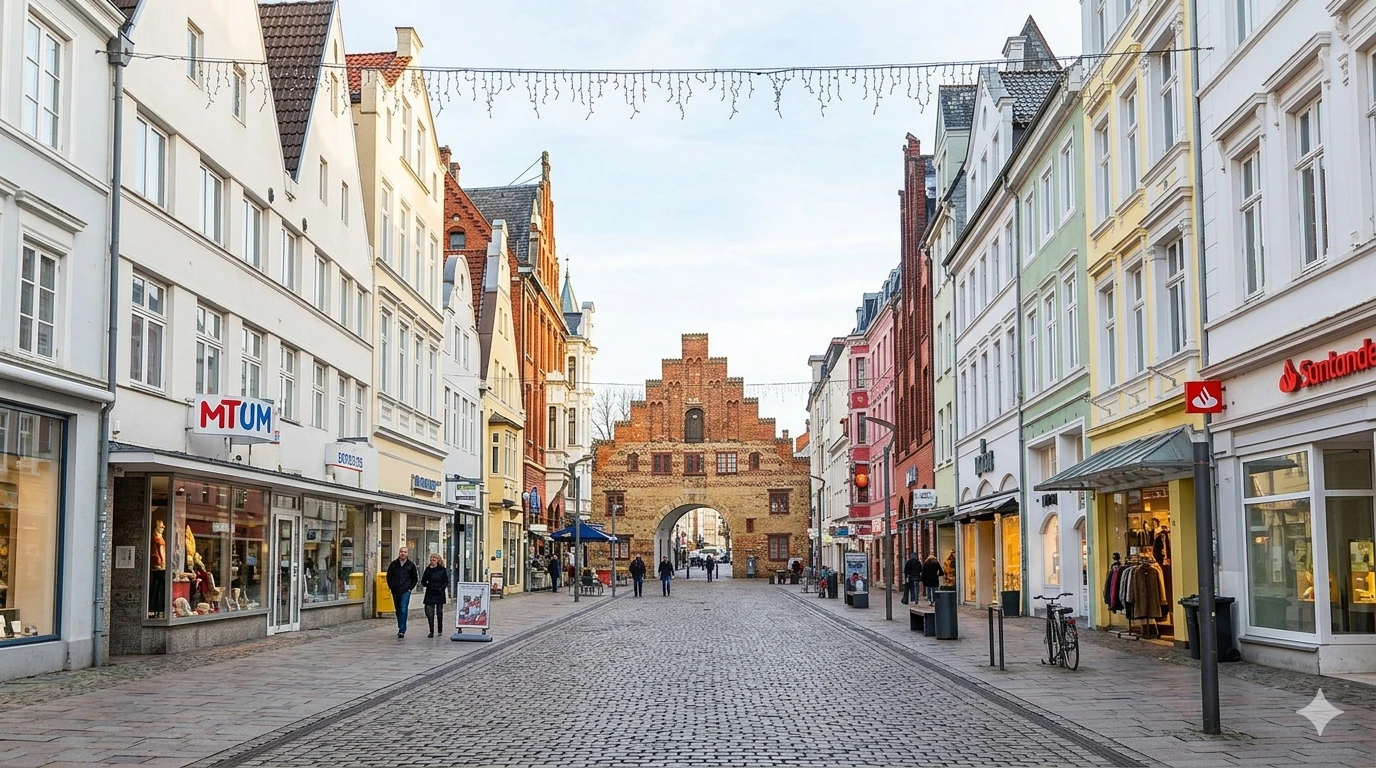
In 1284, Flensburg received its town charter. The streets that were laid out in those early decades — Große Straße running north-south, the market squares at each end, the narrow lanes dropping toward the water — are still where they were. The names on the shop fronts have changed. The bones of the place have not. Walking the Altstadt feels less like visiting a heritage site and more like watching a city that simply got on with things for eight centuries.
What Is Flensburg’s Old Town?
Flensburg’s Altstadt is the historic centre of the city, running roughly from Nordermarkt in the north to Südermarkt and the harbour in the south — a stretch of about 800 metres that contains the bulk of the city’s medieval and early modern street plan.
At its widest point it is barely half a kilometre across. Within that space you get merchant townhouses from the 1600s sitting next to 19th-century civic buildings, half-timbered courtyard entrances tucked behind modern shopfronts, and the smell of coffee drifting out of basement cafés that have been serving something hot since before the city decided which country it belonged to.
Flensburg spent centuries as one of the busiest trading ports between Hamburg and Scandinavia. That trade — rum from the Caribbean, grain from Denmark, herring from the Baltic — left its mark in the architecture. The wide doorways and solid courtyard gates were built for carts loaded with goods, not pedestrians. Some of those same gates are still here, and some of the courtyards behind them have been turned into some of the city’s best small restaurants and independent shops.
The Old Town sits in Schleswig-Holstein, Germany’s northernmost state, just a few kilometres from the Danish border. That dual identity — legally German, culturally Danish-inflected — shows up in the food, the street signs, and the way people switch between languages mid-sentence at the market. You can read more about the city’s background on our About Flensburg page.
What to See in the Altstadt
Große Straße — The Main Street
Start at one end and walk the full length of Große Straße. It is the spine of the Old Town and the street that most visitors end up on regardless of where they are trying to go.
The shops here are a mix of local independents, bakeries, and a handful of chains. What makes it worth walking slowly is the architecture above the ground floor — the stepped gables, the proportions of the upper windows, the occasional carved timber frame that survived the 20th century. Look up, not in.
Nordermarkt and Südermarkt
The two market squares bookend the main street and are as different in character as they are similar in shape.
Nordermarkt sits beneath the shadow of the St. Mary’s Church tower and feels more civic, more formal. The Saturday market sets up here in the mornings. Südermarkt, down near the harbour, is where the city congregates in summer, where the Christmas Market runs in December, and where the bars put their tables outside on warm evenings.
The Höfe — Flensburg’s Inner Courtyards
If you only do one thing in the Altstadt, step through one of the old courtyard gates off Große Straße.
These hidden inner yards — called Höfe in German — were originally the working courtyards of merchant houses, where goods were stored, ships’ supplies loaded, and deals made away from the public street. Several have been restored and now contain galleries, studios, and small restaurants. Norderstraße and the lanes around it have a good concentration of them. None are signposted in any obvious way, which is exactly the point.
Nordertor Gate
At the northern end of the Altstadt stands Nordertor, the city’s surviving medieval gate, built in 1595 when Flensburg was still a walled city trading hard with the Baltic and the Caribbean. It is one of the most photographed spots in the city and one of the only places where you can get a clear sense of what the original city boundary looked like.
You can read a full guide to Nordertor Gate including the best angle to photograph it and what is inside. It is free to walk through and is accessible on foot from anywhere in the Old Town in under five minutes.
Rum Museum
The Flensburg rum trade is one of the more interesting commercial histories in northern Germany — and it is told in full at the Rum Museum on Lützowstraße, a ten-minute walk from Nordermarkt. The city became Germany’s main rum port in the 18th century through trade with the Danish West Indies, and the legacy of that trade still shows up in the Altstadt’s architecture and street names.
The Rum Museum is worth an hour of your time, especially if you have any interest in how a small northern German city became the only place in the country still commercially distilling rum.
Practical Information
Address: Große Straße / Nordermarkt, 24937 Flensburg (the Old Town is a district, not a single address — start at Nordermarkt) Admission: Free to walk and explore. Individual museums charge separate fees. Best time to visit: Weekday mornings are quietest. Saturday mornings bring a market to Nordermarkt that is worth arriving early for. Summer evenings, when the cafés spill onto the squares, have a different energy again. Accessibility: The main streets are flat and paved. Some of the inner Höfe have uneven cobblestones. The lanes near Museumsberg slope uphill.
Getting There
The Old Town is central — it is, effectively, the city centre. From Flensburg central station (Hauptbahnhof), it is a 10-minute walk heading north. The bus network also runs into the centre, with stops on or near Nordermarkt.
If you are arriving by car, there are car parks on the periphery of the Old Town at Am Ochsenmarkt and near the harbour. Driving into the pedestrian zone is not possible. For a wider regional exploration — particularly for a day trip to Denmark — car rental in Flensburg is worth considering, since the Danish border is only 7 kilometres north.
Insider Tips
1. Go early on a Saturday. The Nordermarkt market gets busy by 10am. Arriving at 8:30 means you can walk the stalls before the main street fills up and grab a coffee from the bakery on the corner while the square is still quiet.
2. The courtyards are not obviously marked. The best Höfe are through doorways that look like they lead to nothing. If there is an old painted archway or a heavy wooden gate on a side street, push it open. Most are accessible during the day and several connect through to other streets.
3. Walk south toward the harbour last. The connection between the Altstadt and the waterfront is one of the best things about Flensburg — you can go from a 16th-century gate to a working harbour in four minutes on foot. Save the transition for the end of your walk and arrive at Flensburg Harbour with some appetite. The cafés on Schiffbrücke are better than anything on the main tourist drag.
Tours of Flensburg Old Town
If you would prefer to walk the Altstadt with a local guide rather than independently, guided city tours of Flensburg are available through GetYourGuide. These typically run 90 minutes to two hours and cover the main streets, the Höfe, and the historical context that is easy to miss without someone pointing it out.
Where to Stay Nearby
The Old Town is walkable from almost every hotel in central Flensburg. If you want to be within genuine walking distance of the Altstadt and the harbour, the hotels in Flensburg closest to the waterfront put you right in the middle of it — some of the options on the harbour front are a five-minute walk from Nordermarkt.
For specific recommendations and prices, see our full guide to where to stay in Flensburg.
Also Worth Visiting
Museumsberg Flensburg — The city’s main art and cultural history museum sits on a hill just east of the Old Town, with views back across the rooftops. It holds one of the best collections of regional art and applied arts in Schleswig-Holstein.
Flensburg Harbour (Schiffbrücke) — The southern edge of the Altstadt opens directly onto the harbour. The working waterfront, the old trading warehouses, and the cafés along Schiffbrücke are worth spending time at after you have walked the Old Town’s main streets.
Flensburg Firth — The fjord that the city sits on extends 40 kilometres into Denmark. From the harbour, you can see straight down it on a clear day. Walking or cycling along the shoreline north of the city is one of the better things to do in Flensburg if you have a full day.
Explore all of our recommended things to do in Flensburg for more ideas.
Is Flensburg Old Town free to visit?
Yes, walking through Flensburg’s Altstadt is completely free. The streets, market squares, and courtyards are open to the public at all times. Individual museums and galleries within the Old Town charge separate admission.
How long should I spend in Flensburg’s Old Town?
Give yourself at least two hours to walk the main streets properly — Große Straße, Nordermarkt, and the lanes toward the harbour. If you plan to visit the Rum Museum or Museumsberg as well, allow half a day.
Is Flensburg Old Town walkable?
Fully walkable, and compact enough that nothing in the Altstadt is more than ten minutes on foot from anything else. The main streets are flat, though the lanes near Museumsberg slope uphill. Comfortable shoes are recommended on the older cobbled sections.
What is Flensburg’s Old Town known for?
The Altstadt is known for its well-preserved 17th and 18th century merchant architecture, the Nordertor gate (built 1595), the inner courtyards — called Höfe — that were once the private yards of rum traders, and the direct connection to the historic harbour at Schiffbrücke.
Can I visit Flensburg Old Town in winter?
Yes. December is actually a strong time to visit — the Christmas Market runs on Südermarkt and Nordermarkt throughout the month, and the Old Town’s narrower lanes take on a different atmosphere in cold weather. Shops and cafés remain open year-round.