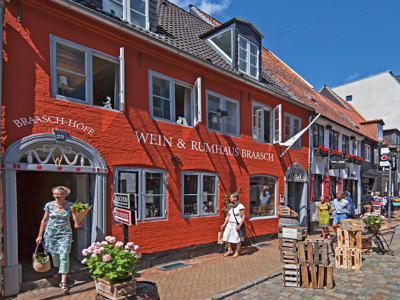
For nearly 200 years, Flensburg was the rum capital of Northern Europe. The Rum Museum on Rote Straße tells that story across three floors of original artefacts, tasting rooms, and a working bottling line that still produces small-batch rums using 19th-century methods.
The History in Brief
In 1755, the Danish King Frederik V granted Flensburg merchants the right to import sugar cane directly from the Danish West Indies (now the U.S. Virgin Islands). Within a decade, more than 200 ships were sailing the route. The captains brought back not just sugar but molasses, casks, and the knowledge to distil — and Flensburg’s rum industry was born. At its peak in the 1860s, the city had over 200 active rum houses.
What You’ll See
Ground floor — The trade route. Original cargo manifests, ship’s instruments, and a recreation of a 1820s merchant’s office. The interactive map shows every documented voyage between 1755 and 1864.
First floor — The production. Real wooden fermenting vats, copper stills, and a working bottling line. Live demonstrations on weekends.
Top floor — The tasting room. A guided flight of four rums, each from a different Flensburg house, paired with an explanation of what makes each distinct. The Hansen 1864 reserve is particularly worth the upgrade.
Tasting Tour vs. Standard Entry
Standard entry (€8) gives you the museum without tastings. The Tasting Tour (€18) includes four guided pours and is genuinely the better deal — you learn far more by tasting than by reading.
Practical Tips
- Booking: Tasting tours sell out at weekends; book online a week ahead
- Languages: Tours run in German and English; Danish on Saturdays
- Time needed: 90 minutes for standard, 2 hours with tasting
- Age: Tasting tour is 18+; under-18s welcome on the standard tour
- Accessibility: Lift to all floors
After the museum, walk five minutes to the Captain’s Quarter to see the merchant houses these traders actually built and lived in.